
If you’ve ever asked for a rubbish removal estimate, you’ve heard your junk described in cubic metres. So how big is a cubic metre of rubbish? Here’s what one actually looks like, and how to work out roughly how many you’ve got.
A cubic metre is a measurement of volume. Picture a box one metre long, one metre wide and one metre high — everything that fits inside that imaginary box is roughly 1 m³.
One cubic metre is also 1,000 litres. A standard Brisbane kerbside wheelie bin holds 240 litres, so 1 m³ is about 4.2 full wheelie bins. Enough loose rubbish to fill roughly four household bins is about a cubic metre.
This is where it gets a bit rubbery. A neat stack of boxes fills a cubic metre efficiently; a pile of chairs and branches is mostly air. As a rough visual guide, 1 m³ is about:
Push everything into one tidy heap. A sprawling mess measures far bigger than it really is — and you’d be paying for the gaps.
Length, width and height, in metres. Big paces work in a pinch — one adult stride is close enough to a metre for a rough estimate.
2 m long × 1.5 m wide × 1 m high = 3 m³. Uneven heap? Take the average height rather than the tallest point.
Bulky, awkward loads — mattresses, branches, furniture — don’t pack down. Add roughly 20% for anything that won’t sit flat.
Start with the shape itself. One cubic metre is a cube measuring one metre on every side — a metre long, a metre wide, a metre high.
Stand a metre stick on the floor — that’s hip height on most adults. Now picture that same distance in all three directions. Most people underestimate it badly: a single cubic metre swallows a surprising amount of junk.
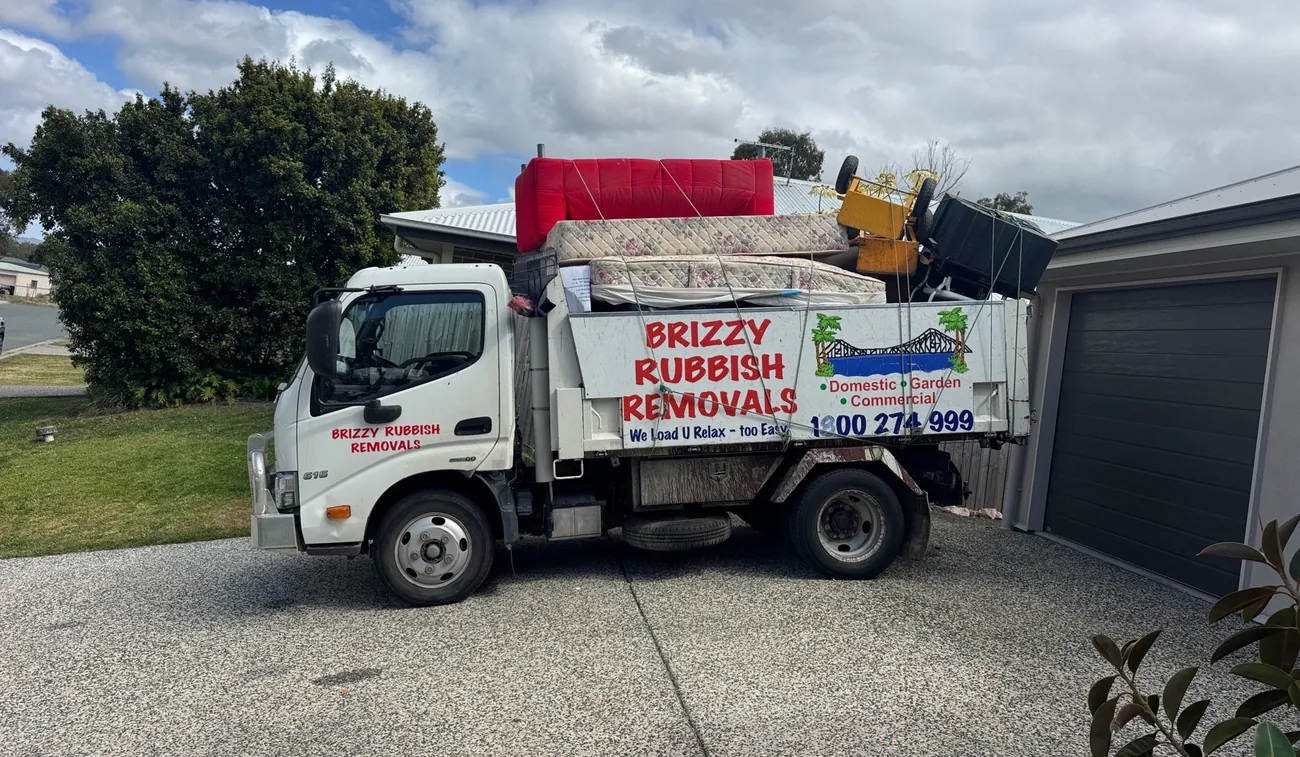
Our rubbish removal trucks hold approximately 7.5 cubic metres. So one cubic metre is roughly one-seventh to one-eighth of a truckload — about 13% of the space.
Volume is what we’re actually charging for: once the truck’s full, it’s full. Knowing roughly how many cubic metres you’ve got helps you picture the size of the job before we come out to give you a free onsite estimate.
Measure a dining table and four chairs where they stand and you’ll get a big number. Chairs stack, tables go on their side, and the load packs down to a fraction of that. Same story with lounges, bed frames, desks, shelving and wardrobes.
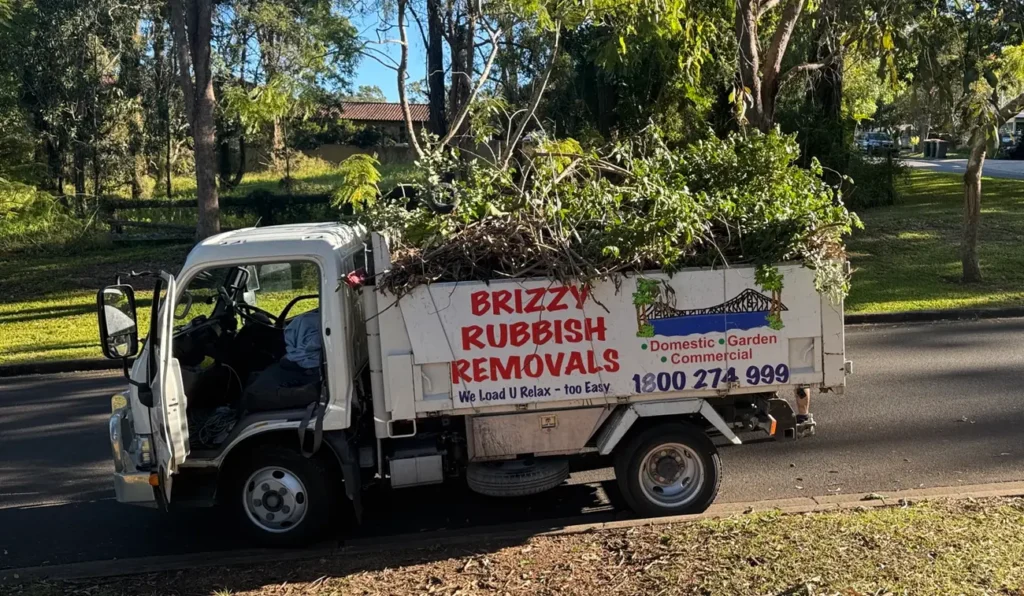
Branches, palm fronds and hedge trimmings are mostly air pockets. A pile that looks enormous from the back door can be two or three cubic metres once it’s loaded, and two piles that look identical can differ wildly. Photos help us get a sense of green waste jobs before we come out to measure up.
Honestly, this is the easiest option. Photos help us understand the job before we come out for a free onsite estimate. Stand far enough back to get the whole pile in frame, and include something that gives a sense of scale. A few angles beats one.
Good things to include for scale:
Estimating rubbish volume isn’t something most people do every day.
So if you’re looking at a pile in your garage, garden, office or spare room and wondering whether it’s 1 m³ or 3 m³, don’t worry. A rough indication is useful, but you don’t have to calculate it yourself before contacting us. We’ll work out the volume when we come out for your free onsite estimate.
About 4.2 standard 240-litre kerbside bins, since one cubic metre is 1,000 litres.
Roughly 2 m³ level-loaded, or 3–4 m³ heaped with the sides built up.
Approximately 7.5 m³, so a single cubic metre is about 13% of a truckload.
No. A rough idea helps, and photos with a short description are useful, but we’ll work out the volume when we come out for your free onsite estimate.
A typical three-seater at 224 × 91 × 86 cm works out to about 1.75 m³ — close to a quarter of our truck.
Send a few photos and a description of what needs to go, and we’ll arrange a free, no-obligation onsite estimate anywhere across Brisbane.
Copyright ©